Showing posts with label alexithymia. Show all posts

November 9, 2023

Alexithymia in MS - or what am I feeling, anyway?

 Big word. Confusing to pronounce. SO what is it, exactly? 

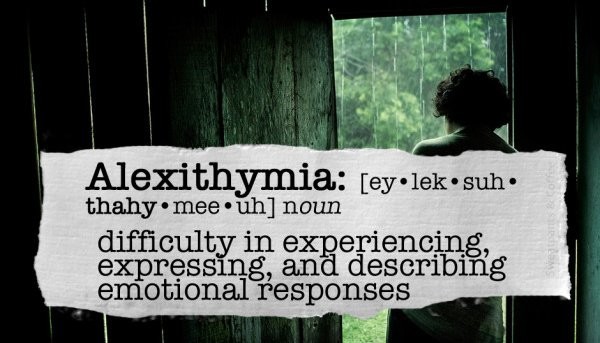
Alexithymia (/əˌlɛksɪˈθaɪmiə/ ə-LEK-sih-THY-mee-ə), also called emotional blindness, is a neuropsychological phenomenon characterized by significant challenges in recognizing, expressing, and describing one's own emotions. It is associated with difficulties in attachment and interpersonal relations.Emotional (Un)awarness - Dealing with Alexithymia

It's common in autism, depression, and brain damage. What does it look like?

- inability to identify or describe emotions; mixing up physical sensations and emotions

- difficulty understanding how others feel

- difficulty understanding social cues

- difficulty with self-assessment and introspection

- limited creativity, imagination, and fantasies

- focus on logical and matter-of-fact thinking

From my readings, it's one of those things that are common in MS, along with failing to accurately read facial emotions. (the "mind in the eyes" test).

This explains a lot of my interactions with life. I frequently feel out of step with social cues. Ask me how I feel and I'll struggle to describe it, which makes writing a bit of a challenge. It also explains my shift from creating stories to editing them.

But where it can wreak the most havoc is in relationships with friends, family, partners. How can you be understood if you don't understand yourself? How can you understand others if you are emotion-blind?

There has been a lot of research lately into this aspect of MS, but these are largely small studies and observational - and they say things like, yes, it's linked - but there's no indication of how to work through it, how to improve your emotional view, how to explain it to your near and dear.

There is some help through the already-overtaxed autism resources, as it and autism are buddies. How do you know if you are dealing with it, especially with lack of self-introspection and ability to describe how you feel? 

Well, as you'd suspect, there are helpful online tests! It's listed as an autism test, but this does not mean you have autism, just that the brain damage caused by MS is altering your responses. I found it revealing, if a bit disconcerting. Why not check it out: 

Toronto Alexithymia Scale

If nothing else, you can take it to your health care provider or show to your family to illustrate what you are dealing with. And in terms of working on things to make relationships better, it's a good place to start. 

We can all do with a bit more self-awareness, right?

Well, at least I can.

April 15, 2017

Whatever do you mean?


Ah yes. MS and relationships. I'm working on a book about how to liven up your intimate relationships even with MS and the research is mind-blowing. Well, it can be fun, too, but I digress...


Like, for example - did you know that one of the cognitive changes that comes with MS is the gradually increasing social disorder of not being able to read other's emotions/faces, and not being able to express our own?

What may be overlooked in relating to and caring for patients with multiple sclerosis is the fact that the neurodegenerative disease sometimes affects a person’s ability to properly convey and perceive emotion. According to the National Multiple Sclerosis Society (NMSS), while there is not enough conclusive evidence to suggest the disease directly affects emotion, it is important to consider that MS patients may either be struggling to cope with the disease, or are physiologically affected by it, making perception and expression beyond their control.
Aside from the loss of the ability to recognize the appropriate emotion behind certain expressions, a new study from the International School of Advanced Studies (Scuola Internazionale Superiore di Studi Avanzati or SISSA) in Italy now suggests MS patients have an increased difficulty interpreting emotions expressed through one’s posture, countenance, and comportment. Additionally, the study suggests these issues are caused by the patient’s inability to identify his or her own emotions, which is a phenomenon termed as alexithymia, and is observed in some MS patients.”⁠1 (Emphasis mine)


1 http://multiplesclerosisnewstoday.com/2014/11/12/inability-to-recognize-and-convey-emotion-an-effect-of-ms/ Accessed Mar 30, 2016

Alexithymia. A new multi-syllabic word to whisper in our partner's ear, late at night.

"I'm so sorry, darling, I didn't realize you were upset. You see, I have alexithymia..."
Related image
I'm so sure that will be the curative word...relationship fixed. "Oh, I see, you can't express or understand expressed emotion. So how SHOULD I reach you? Flash cards?"


Maybe flash cards or one of those "Daily Mood" flipcharts would be a good idea if only to help identify our feelings to ourselves. Because, apparently we can lose that, too.

Definition: Alexithymia

Alexithymia is defined as a personality construct characterized by the sub-clinical inability to identify and describe emotions in the self. The core characteristics of alexithymia are marked dysfunction in emotional awareness, social attachment, and interpersonal relating. Furthermore, individuals suffering from alexithymia also have difficulty in distinguishing and appreciating the emotions of others, which is thought to lead to un-empathic and ineffective emotional responding...
The treatment options for alexithymia are often times very different from typical counseling or talk therapy. For people living with alexithymia, a mental health professional will often concentrate on building a foundation of naming emotions and appreciating a range of feelings. The process will likely include both consideration of the experiences of other people and self-reflection. Even though some people with this emotional comprehension might sound very basic to others, for a person with alexithymia the process of growing their emotional intelligence and capacity may be difficult. Things such as:
  • Group therapy
  • Daily journaling
  • Skill-based therapy
  • Engaging in the creative arts
  • Various relaxation techniques
  • Reading emotional books or stories
  • https://www.disabled-world.com/health/neurology/alexithymia.php, accessed April 2017
Image result for i'm angry with you
Brain injury changes us, no matter how it is caused. The brain injury that comes with MS evolves daily and is still being understood. For the people around us, our emotional winds can blow a bit strongly. And for us, the hurt that we may inadvertently cause adds to our isolation, something all people with chronic disease suffer.

I seriously dislike the word challenge - it seems to mean we can overcome whatever it is. I haven't heard of too many people who overcame brain damage. I think in this case, we could call it a botheration. Annoying, non-fatal, often not big enough to kill us, but certainly big enough to maim some of our closest relationships.

 I suppose it all comes down to communication, understanding, and a fair dose of tolerance. Knowing about it helps. Reading about this was for me a revelation, a light of understanding why I hesitate so much to connect with people, why friendships remain distant, why I can move away from places without a backward glance. My brain doesn't notice the disconnect.

Mind you, I keep hoping I can dig my way out of this particular brain black hole and find a way to care and express my caring. And perhaps, someone like this:

Image result for i'm angry with you